Ion Size-Dependent Flow Modulation and Selectivity in Polyelectrolyte Grafted Nanochannels under Combined Electroosmotic and Pressure-Driven Transport
Amit Malick, Bhanuman Barman
Том 88 №5
105 просмотров;
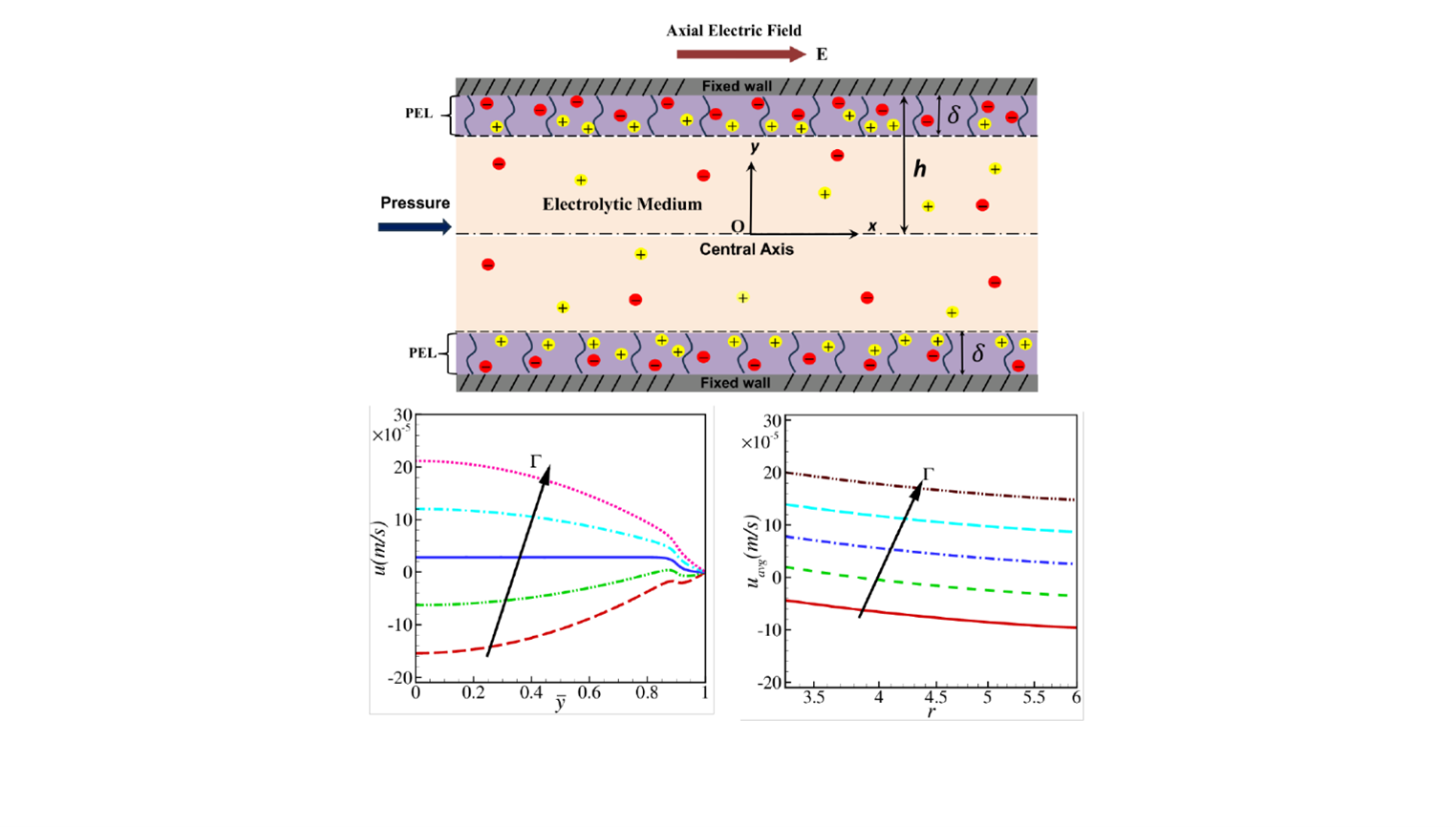
We propose a detailed study of the electroosmotic and pressure-driven flow of power-law fluids through soft nanochannels grafted with polyelectrolyte layers (PELs). The model incorporates the effects of finite ion size using the Carnahan−Starling-based ionic activity coefficient, ion separation caused by the Born energy difference at the PEL-electrolyte interface, and the dielectric permittivity contrast between the two media, all of which are incorporated in a modified Poisson−Boltzmann framework. A power-law model represents the fluid's non-Newtonian rheology, allowing for the consistent treatment of both shear-thinning and shear-thickening behaviours under typical nanochannel configurations. The fluid flow in and outside of the polymer brush layer is described using modified Darcy−Brinkmann and Cauchy momentum equations, accounting for both no-slip and interfacial slip conditions. Numerical solutions using finite difference approaches go beyond the limited Debye−Hückel linearization, allowing reliable predictions even at high surface charge densities. The results reveal that increasing ion size and flow behaviour index reduces average flow velocity, whereas high pressure gradients and fixed charge density increase it. Ion selectivity in shear-thinning fluids decreases with increasing pressure gradient due to hydrodynamic dominance over electrostatic interactions, while viscous drag maintains high selectivity. These findings offer new insight on coupled electrohydrodynamic transport in soft nanochannels and provided an improved foundation for designing next-generation nanofluidic devices for ion separation, purification, and biosensing applications.