Adsorption of Phenolic Compounds onto Reusable CeO2@SiO2 Nanocomposites: Kinetics, Equilibrium, and Thermodynamics in Batch and Column Systems
H. Zeidan, E. Erunal, M. E. Marti
Том 88 №5
92 просмотров;
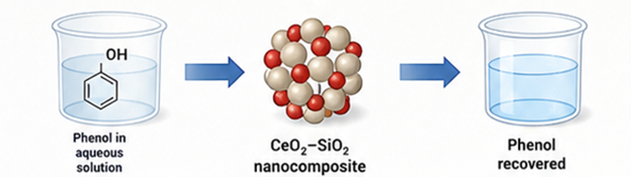
The recovery of phenol from aqueous solutions using CeO2−SiO2 nanocomposites was investigated. The optimal pH value for the process was determined to be 3. Higher phenol concentration decreased separation efficiency while enhancing increasing adsorption capacity. Conversely, increasing the adsorbent dosage led to a higher separation efficiency but lower adsorption capacity. The highest adsorption capacity (136 mg/g) and maximum efficiency were achieved with CeSi-3 (CeO2:SiO2=1:0.5), which possesses the highest cerium oxide content. Higher temperatures reduced both adsorption efficiency and capacity. Thermodynamic parameters indicate that the process is non-spontaneous and exothermic. The isotherm, thermodynamic, and kinetic analyses demonstrated that the adsorption process was governed by a combination of physical and chemical interactions. Complete desorption (100%) was achieved using 0.5 M NaOH, and following ten reuse cycles of CeSi-3, the removal efficiency decreased from 72 to 50%. Column studies revealed that adsorption capacity was influenced by flow rate and bed height. The maximum adsorption capacity (qe=63.3 mg/g) was achieved at a flow rate of 3 mL/min and a bed height of 80 mm. In this research, CeO2−SiO2 nanocomposites exhibit significant potential for sustainable recovery of phenolic compounds, according to their superior performance, reusability, and efficient desorption capabilities.The recovery of phenol from aqueous solutions using CeO2−SiO2 nanocomposites was investigated. The optimal pH value for the process was determined to be 3. Higher phenol concentration decreased separation efficiency while enhancing increasing adsorption capacity. Conversely, increasing the adsorbent dosage led to a higher separation efficiency but lower adsorption capacity. The highest adsorption capacity (136 mg/g) and maximum efficiency were achieved with CeSi-3 (CeO2:SiO2=1:0.5), which possesses the highest cerium oxide content. Higher temperatures reduced both adsorption efficiency and capacity. Thermodynamic parameters indicate that the process is non-spontaneous and exothermic. The isotherm, thermodynamic, and kinetic analyses demonstrated that the adsorption process was governed by a combination of physical and chemical interactions. Complete desorption (100%) was achieved using 0.5 M NaOH, and following ten reuse cycles of CeSi-3, the removal efficiency decreased from 72 to 50%. Column studies revealed that adsorption capacity was influenced by flow rate and bed height. The maximum adsorption capacity (qe=63.3 mg/g) was achieved at a flow rate of 3 mL/min and a bed height of 80 mm. In this research, CeO2−SiO2 nanocomposites exhibit significant potential for sustainable recovery of phenolic compounds, according to their superior performance, reusability, and efficient desorption capabilities.