Structural Advances in Sustainable Biosurfactants for Industrial Applications
Bhagwati Arya, M.G.H. Zaidi, Jyoti Maheshwari, Anam Fatima, Abhishek Dusad, Barkha Singhal, Sameena Mehtab
Том 88 №6
22 просмотров;
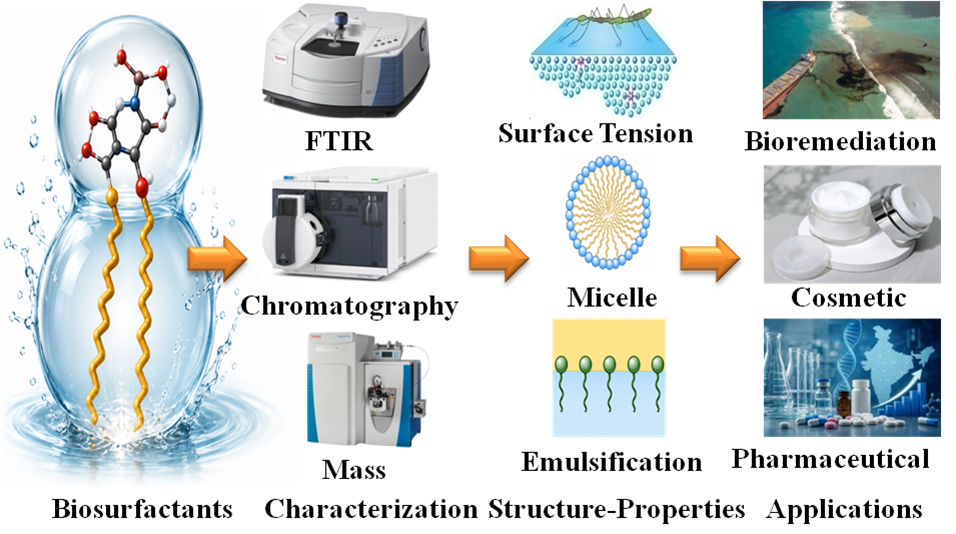
The increasing demand for sustainable and environmentally compatible surface-active agents has intensified interest in biosurfactants as renewable alternatives to petroleum-derived products. Owing to their amphiphilic molecular architecture, biodegradability, comparatively low toxicity, and favorable interfacial properties, biosurfactants have attracted considerable attention for diverse industrial applications. This review critically examines recent advances in biosurfactant research, with particular emphasis on the relationships between molecular structure, colloidal properties, and functional performance. The structural diversity of the major biosurfactant classes, their microbial and renewable sources, and recent advances in analytical techniques, including nuclear magnetic resonance spectroscopy, Fourier transform infrared spectroscopy, mass spectrometry, and chromatographic methods are discussed. The review further examines how head-group chemistry, fatty acid chain length, molecular charge, congener composition, and self-assembly influence surface and interfacial tension reduction, micellization, emulsification, and colloidal stability. Advances in genetic and metabolic engineering are evaluated to illustrate how modification of biosynthetic pathways can enhance production efficiency and enable tailoring of biosurfactant composition for specific applications. Reported structure–property relationships across different biosurfactant classes are evaluated in environmental remediation, enhanced oil recovery, agriculture, food, pharmaceutical, cosmetic, and nanotechnological applications, with consideration of the influence of experimental conditions on measured physicochemical properties. Commercialization challenges related to large-scale production, downstream processing, scalability, and regulatory requirements are also discussed. By integrating advances in structural characterization, structure–property relationships, and engineering strategies, this review provides a critical synthesis of current knowledge and identifies future research directions for the sustainable development of biosurfactants.