Aggregation Behavior and Colloidal Stability of CuO Nanoparticles Prepared by Different Synthesis Routes: Implications for Fuel-Borne Catalytic Additives
Sung-Jin Kim, Myong-Il Pang, Yun-Hyok Kye, Ryong-Jin Kim, Yong-Min Ho
Том 88 №6
10 просмотров;
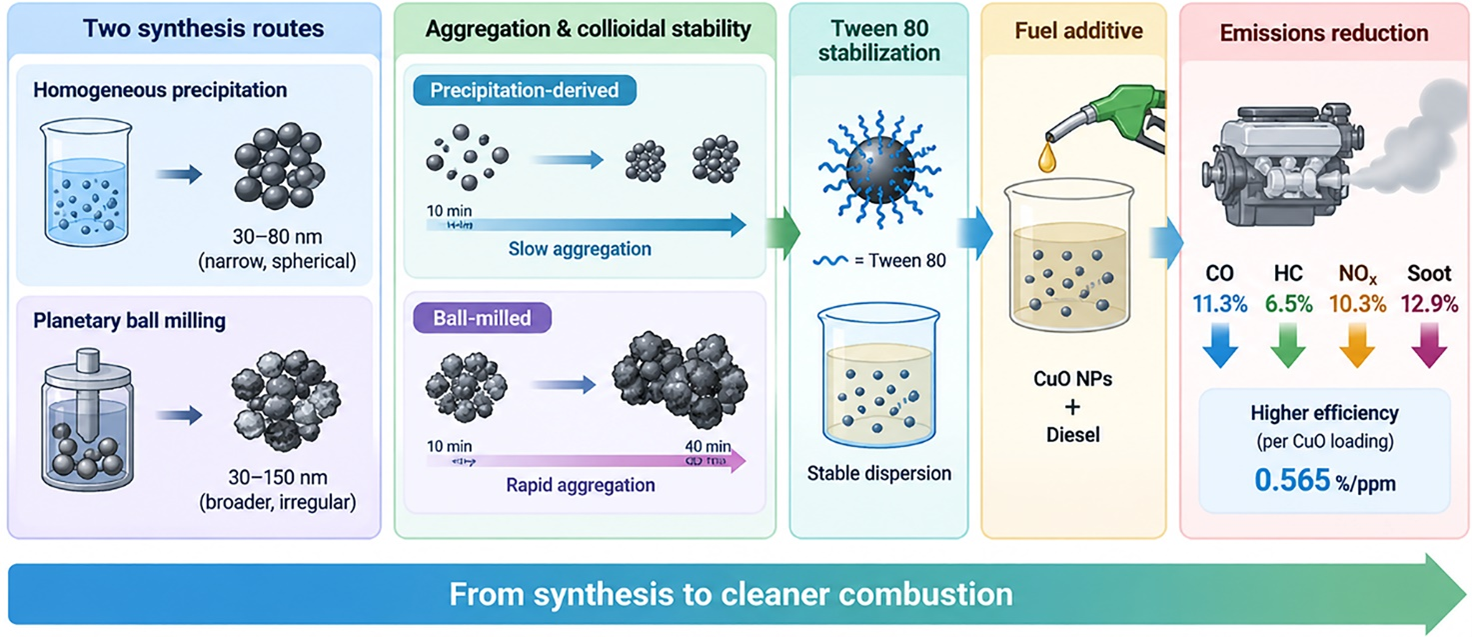
The practical application of CuO nanoparticles as fuel-borne catalytic additives is hindered by poor colloidal stability in organic media, leading to rapid aggregation and sedimentation. This study compares homogeneous precipitation and planetary ball milling in terms of particle size distribution, aggregation behavior, colloidal stability, and resulting catalytic performance. Homogeneous precipitation produced relatively narrow, spherical nanoparticles (30–80 nm), whereas ball milling yielded broader, irregular particles (30–150 nm) with pre-existing agglomerates. Time-resolved laser particle size analysis revealed substantially faster aggregation of the ball-milled particles, with 70.05% exceeding 500 nm within 10 min and 99.91% within 40 min, compared with 0.01 and 65.3%, respectively, for the precipitation-derived particles. Tween80 improved dispersion when added after calcination, consistent with steric stabilization. At 20 ppm CuO in diesel, the precipitation-derived nanoparticles reduced CO, HC, NOx, and soot by 11.3, 6.5, 10.3, and 12.9%, respectively. Although the ball-milled sample at 40 ppm produced greater absolute CO and HC reductions, the precipitation-derived material showed higher emission-reduction efficiency per unit CuO loading and higher nominal BET-surface-area-normalized performance. These results indicate that synthesis-controlled particle size distribution and dispersion can substantially influence the emission-reduction performance of CuO nano-fuel additives.