Control of Particle Size and Colloidal Stability of ZnO Nanoparticles for Enhanced Catalytic Activity in Diesel Emission Reduction
Yong-Min Ho, Sung-Jin Kim,, Myong-Il Pang, Yun-Hyok Kye, Chung-Bom Jon
Том 88 №2
51 просмотров;
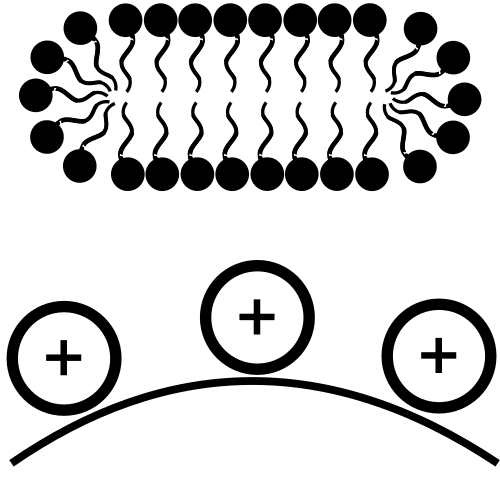
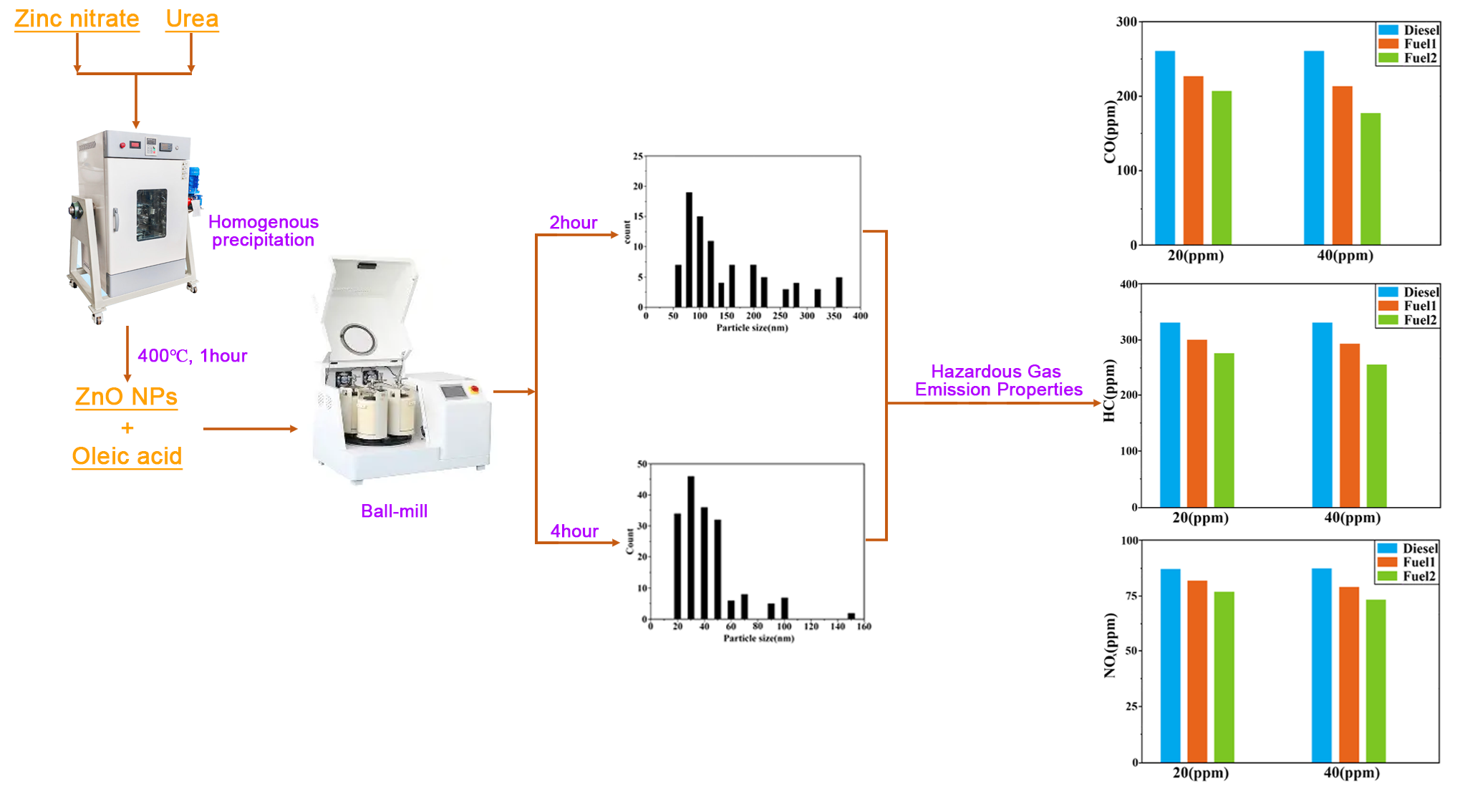
The mitigation of hazardous emissions from diesel engines remains a critical challenge for environmental protection. This study presents a nano-engineering strategy focused on the precise control of particle size and colloidal stability of zinc oxide (ZnO) nanoparticles to reduce carbon monoxide (CO), hydrocarbon (HC), and nitrogen oxides (NOx) emissions. ZnO nanoparticles were synthesized via a homogeneous precipitation method and subsequently engineered through wet planetary ball milling for 2 h and 4 h to achieve tailored primary particle size distributions of 50–120 nm (average: 85 nm) and 20–60 nm (average: 40 nm), respectively. Oleic acid was employed as a surfactant to ensure excellent colloidal stability in diesel fuel, preventing aggregation and maintaining a homogeneous dispersion. The key finding demonstrates that diesel fuel blended with a lower concentration (20 ppm) of the smaller nanoparticles (20–60 nm) achieved superior reductions in CO (14.0%), HC (10.4%), and NOx (5.1%) emissions compared to fuel containing a higher concentration (40 ppm) of the larger nanoparticles (50–120 nm). This result highlights that precise particle size reduction and colloidal stabilization are more effective strategies than simply increasing nanoparticle concentration. The enhanced catalytic activity is attributed to the larger specific surface area and improved interfacial properties of the smaller, well-dispersed nanoparticles, which promote more complete fuel combustion. This work underscores the significant potential of colloidal engineering in developing sustainable and efficient nano-fuel additives, providing fundamental insights for the design of high-performance catalytic systems in energy and environmental applications.